

Texas ECE assistant professor Emanuele Galiffi has received the Nanophotonics Early Career Award. The award acknowledges four early career scientists for their accomplishments, giving them recognition for their outstanding work in the field of nanophotonics.
News

Texas ECE associate professor Hao Zhu has received an Amazon Research Award from the UT Austin-Amazon Science Hub for her work on “Building Capacity for Powering the AWS Datacenters and AI Workloads.”
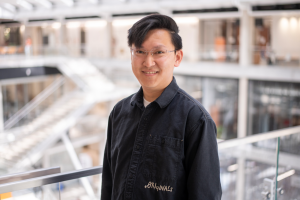
Texas ECE Ph.D. student Yiming Han has been awarded an Outstanding Graduate Research Fellowship from The University of Texas at Austin Graduate School.

Prof. Lizy John of Texas ECE has been selected as a recipient of a Fulbright Specialist Program Award.

Twelve students associated with Texas ECE have been selected to receive prestigious fellowships from the National Science Foundation Graduate Research Fellowship Program (NSF GRFP) for 2026.
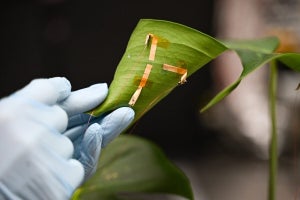

Researchers have developed an electronic tattoo to track moisture levels in plant leaves, potentially leading to improvements in wildfire prediction, agricultural yields, water conservation and food security.

Emanuele Galiffi has been named the recipient of the 2026 Santimay Basu Prize from Union Radio-Scientifique Internationale (URSI).

Professor Radu Marculescu has been recognized as an 2025 AAAS Fellow for his contributions to science and engineering.
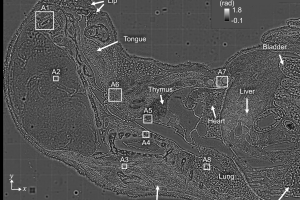
A new microscopy technology developed by researchers from The University of Texas at Austin produced one of the largest and most detailed optical images of complex biological tissue ever created.
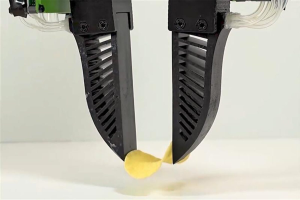
New technology created at UT overcomes one of the biggest hurdles in robotics: sensitive touch.


